01 / Bancolombia
Rebuilding Bancolombia's Post-Sales Banking Ecosystem
Transforming fragmented post-sales journeys into a measurable growth engine.
Read case study ↗But, you can call me Maro. I'm a designer of digital products, passionate about helping organizations to make better decisions, designing better products today while preparing for tomorrow through Strategic Foresight. Currently Product designer at Pragma and Bancolombia.
Transforming fragmented post-sales journeys into a measurable growth engine.
Read case study ↗Replacing paper-based banking requests with a seamless end-to-end digital service.
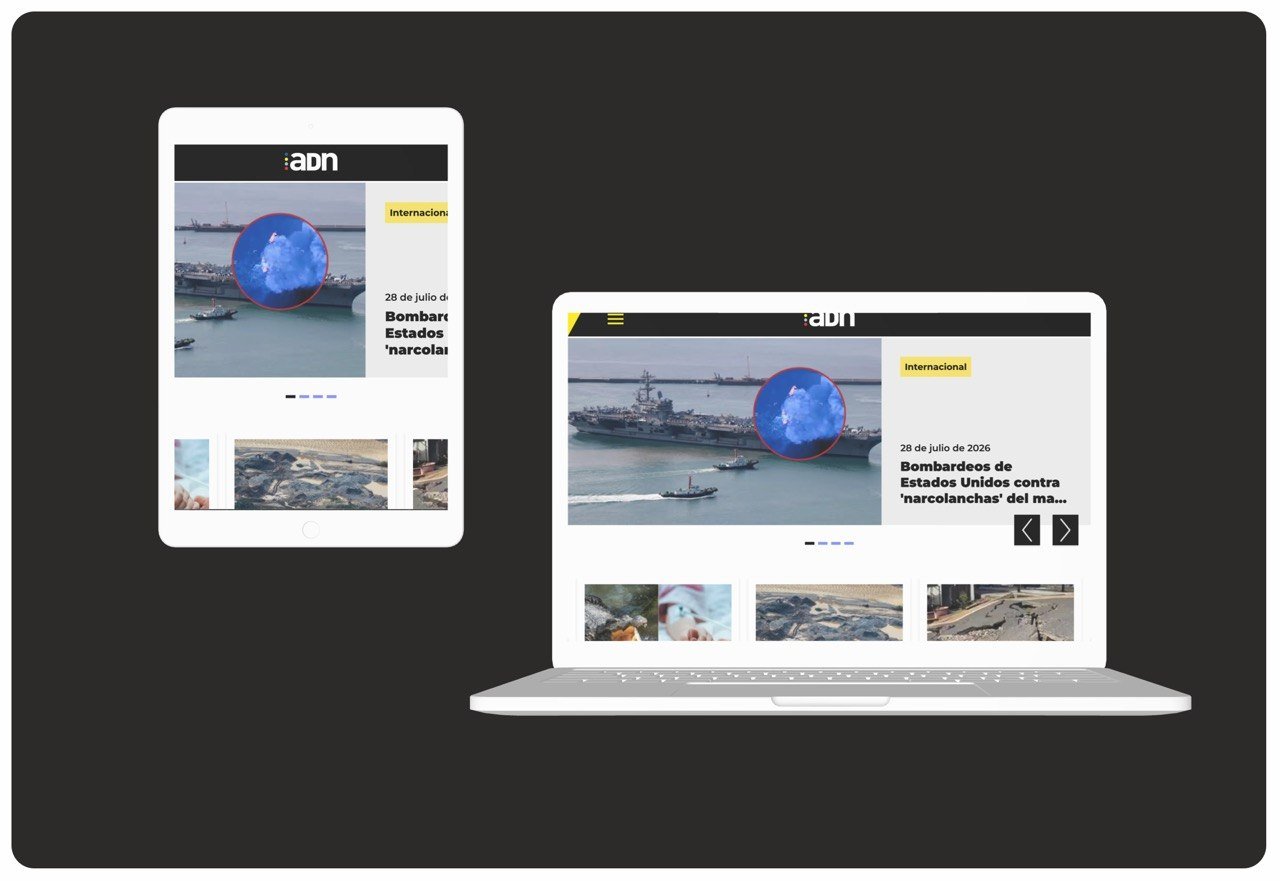
Read case study ↗Expanding a free newspaper beyond the streets into a digital-first experience.
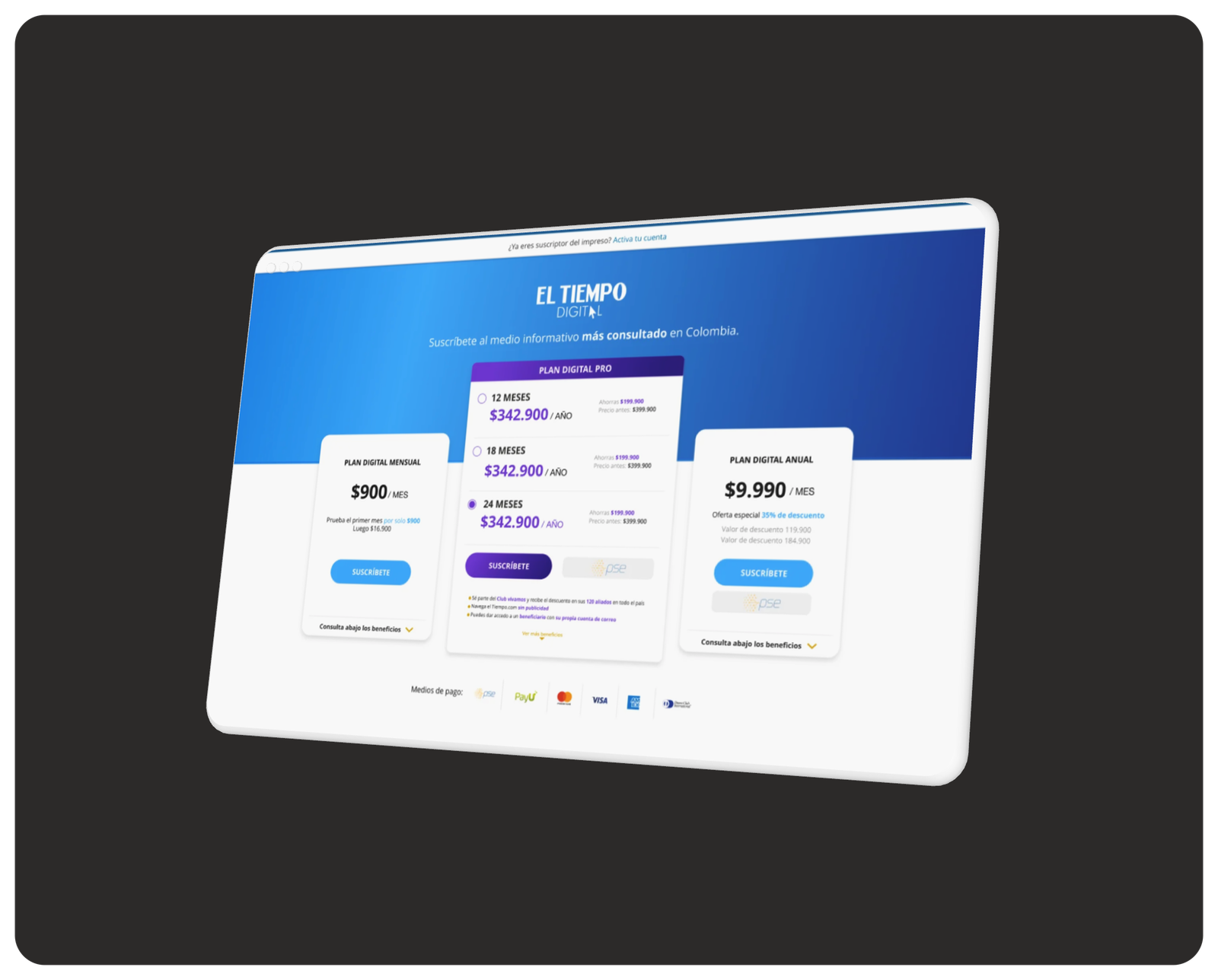
Coming soonHow we redefined EL TIEMPO's subscription strategy by transforming a traditional newspaper into a digital membership experience.
Coming soonI have colaborated with
The projects I'm most proud of are successful not simply because they delivered well-designed interfaces, but because they strengthened the way teams think, collaborate, and make decisions. I believe great product design isn't only about creating better experiences. It's about helping teams and organizations continuously become better at designing them.
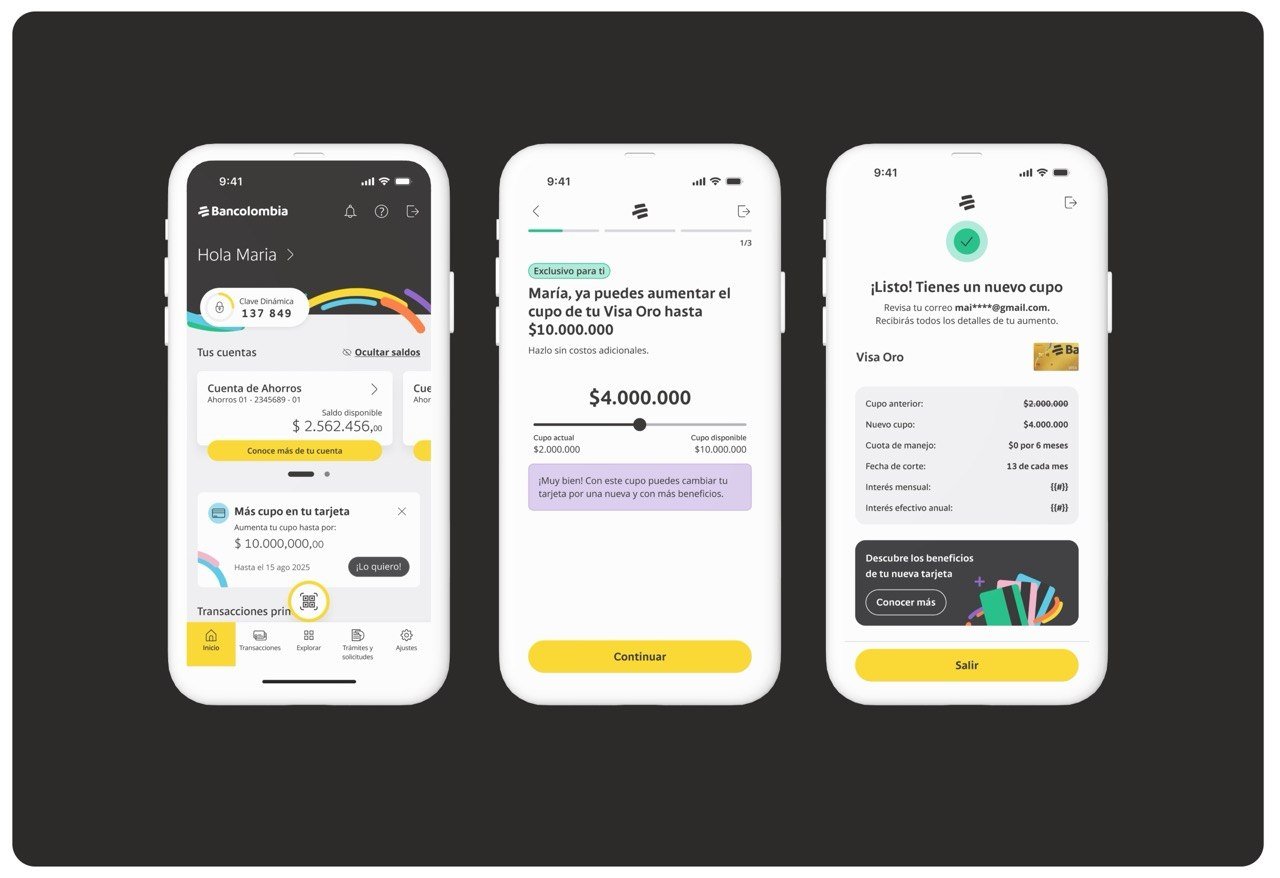
Transforming fragmented post-sales journeys into a measurable growth engine.
When I joined Bancolombia's Experience Design team, I became part of a newly created cross-functional squad established to transform a portfolio of post-sales banking experiences that had received little investment over the years.
These journeys including loan term extensions, credit card limit increases, and debt consolidation loans had evolved independently. Many still relied on outdated interaction patterns and legacy visual styles that no longer reflected the bank's digital experience.
The challenge went beyond usability. These products were underperforming from both customer and business perspectives. Customer adoption was low, key performance indicators had never been clearly defined, and the bank was falling behind competitors in an increasingly digital financial landscape.
Rather than redesigning individual products, our mission was to rebuild an entire ecosystem of experiences that could improve customer engagement while supporting sustainable business growth.
Although these products represented significant business opportunities, they had gradually become disconnected from both customer expectations and the bank's evolving digital ecosystem. Across multiple experiences we identified recurring challenges:
From a business perspective, these products also played an important role in portfolio management. For products such as loan term extensions or credit card limit increases, success wasn't simply measured by transaction completion. The bank also sought to strengthen long-term customer relationships and support healthy portfolio growth through responsible use of financial products.
The challenge wasn't improving isolated journeys. It was rebuilding a fragmented ecosystem into a modern, measurable product portfolio.
Before proposing solutions, we first needed to understand both the internal ecosystem and the competitive landscape. Because these products had already been researched by other teams, our goal wasn't to start discovery from scratch, but to build on existing knowledge.
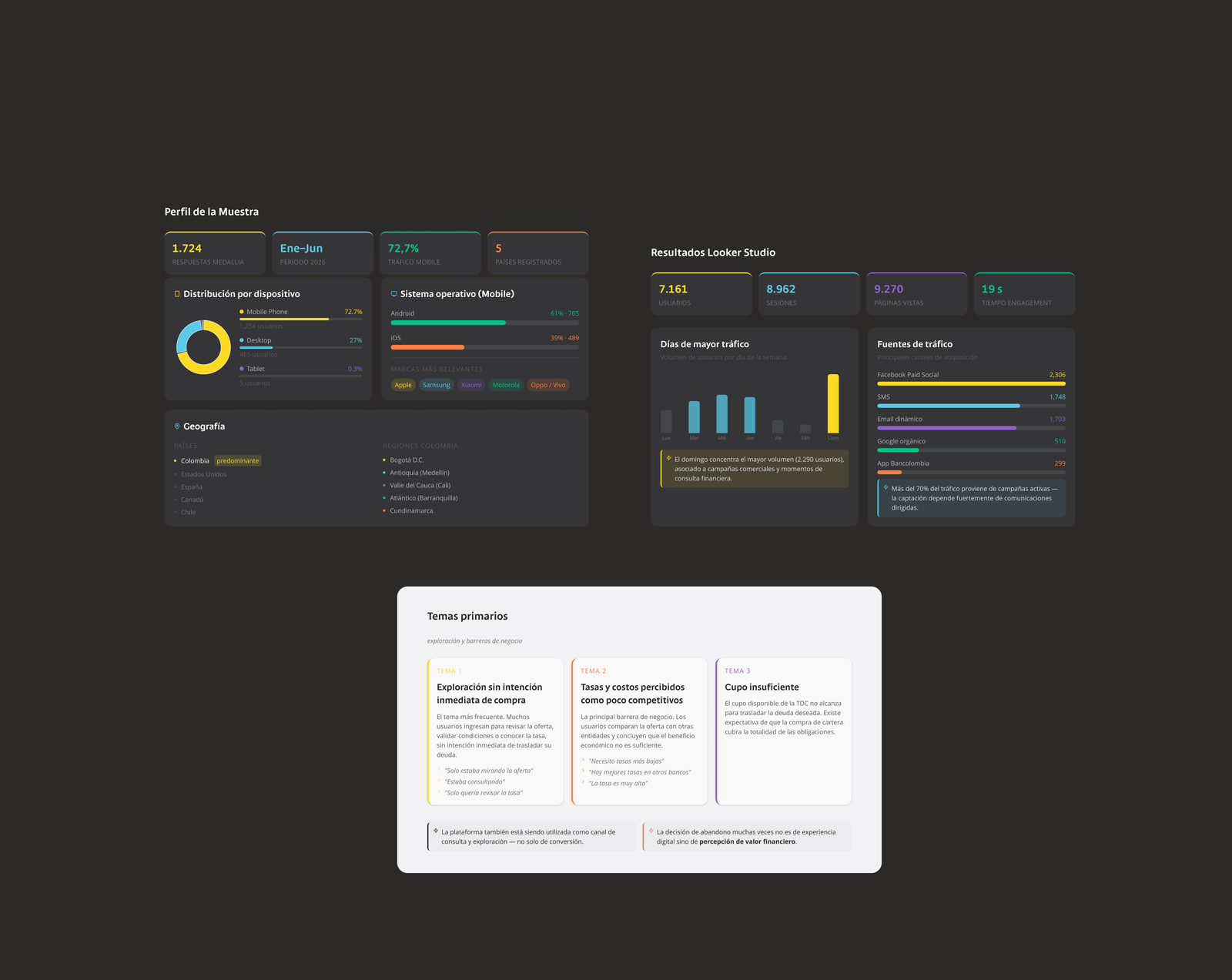
Since multiple teams had previously researched these products, we began by synthesizing existing evidence rather than conducting new user research. We reviewed previous UX studies, customer service reports, product analytics, customer feedback, and internal documentation to identify recurring pain points, behavioral patterns, and business opportunities.
Working closely with Product Owners, Marketing, Product Strategy, Analytics, and Experience Design, we complemented these insights with business objectives, operational constraints, and stakeholder perspectives to build a shared understanding of the ecosystem.
Rather than evaluating each experience in isolation, we looked for recurring patterns and opportunities that affected the portfolio as a whole.
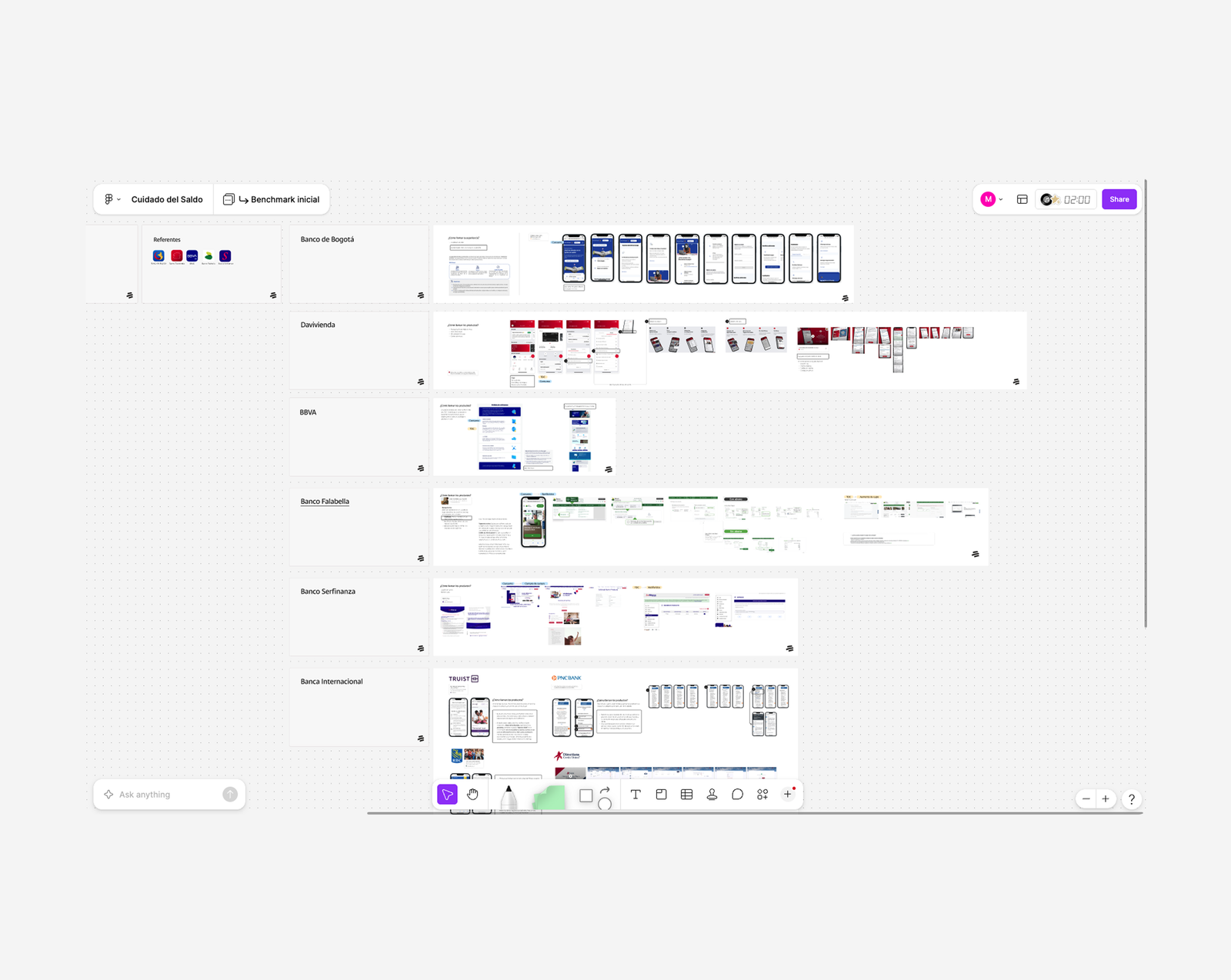
To understand how customer expectations had evolved, we conducted a benchmark of leading financial institutions. We analyzed how competitors:
The benchmark revealed that Bancolombia lagged behind competitors in several aspects, including interaction quality, product discoverability, visual consistency, and digital guidance. These findings helped establish a clear direction for modernization while identifying opportunities to differentiate through customer experience rather than feature parity.
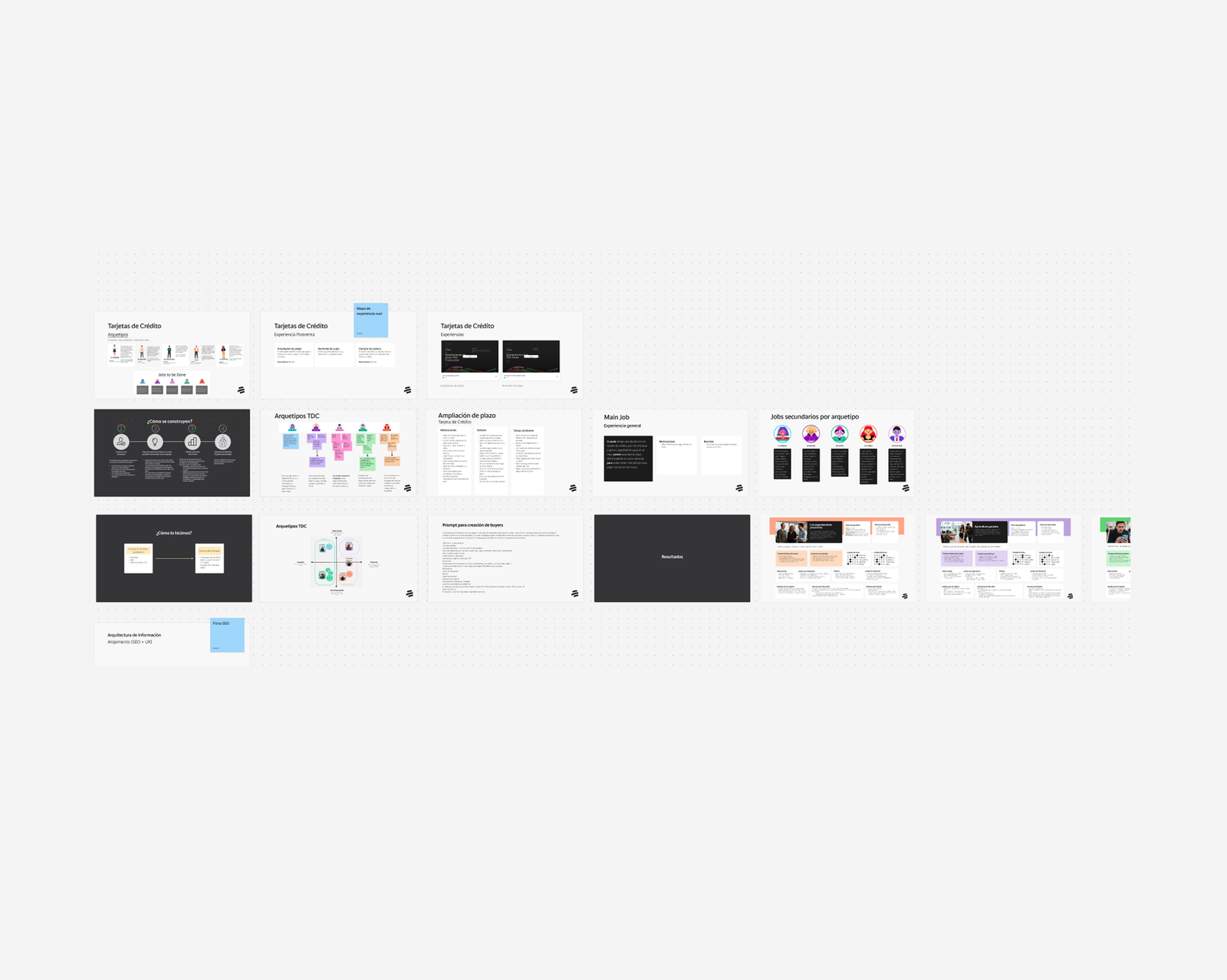
One of the first strategic activities was redefining every product through a Jobs-to-be-Done framework. Rather than asking "How can we improve this screen?" we focused on a more meaningful question:
"What is the customer trying to accomplish when using this product?"
This shift helped align product decisions around customer intent instead of individual features. JTBD became the common language used across design, product, and business discussions.
One of the project's biggest discoveries was the absence of clear success metrics. Without shared KPIs, it was difficult to understand whether improvements actually created value for customers or the business.
Together with Product Owners and stakeholders, we defined experience and product KPIs that allowed us to continuously monitor adoption, conversion, engagement, and business performance. Measurement became part of the design process, not something that happened after launch.
Redesigning every experience simultaneously wasn't realistic. Instead, we developed a phased roadmap organized across multiple quarters. Working collaboratively across disciplines, we defined:
This roadmap aligned business priorities with delivery capacity while ensuring each release generated measurable customer value.
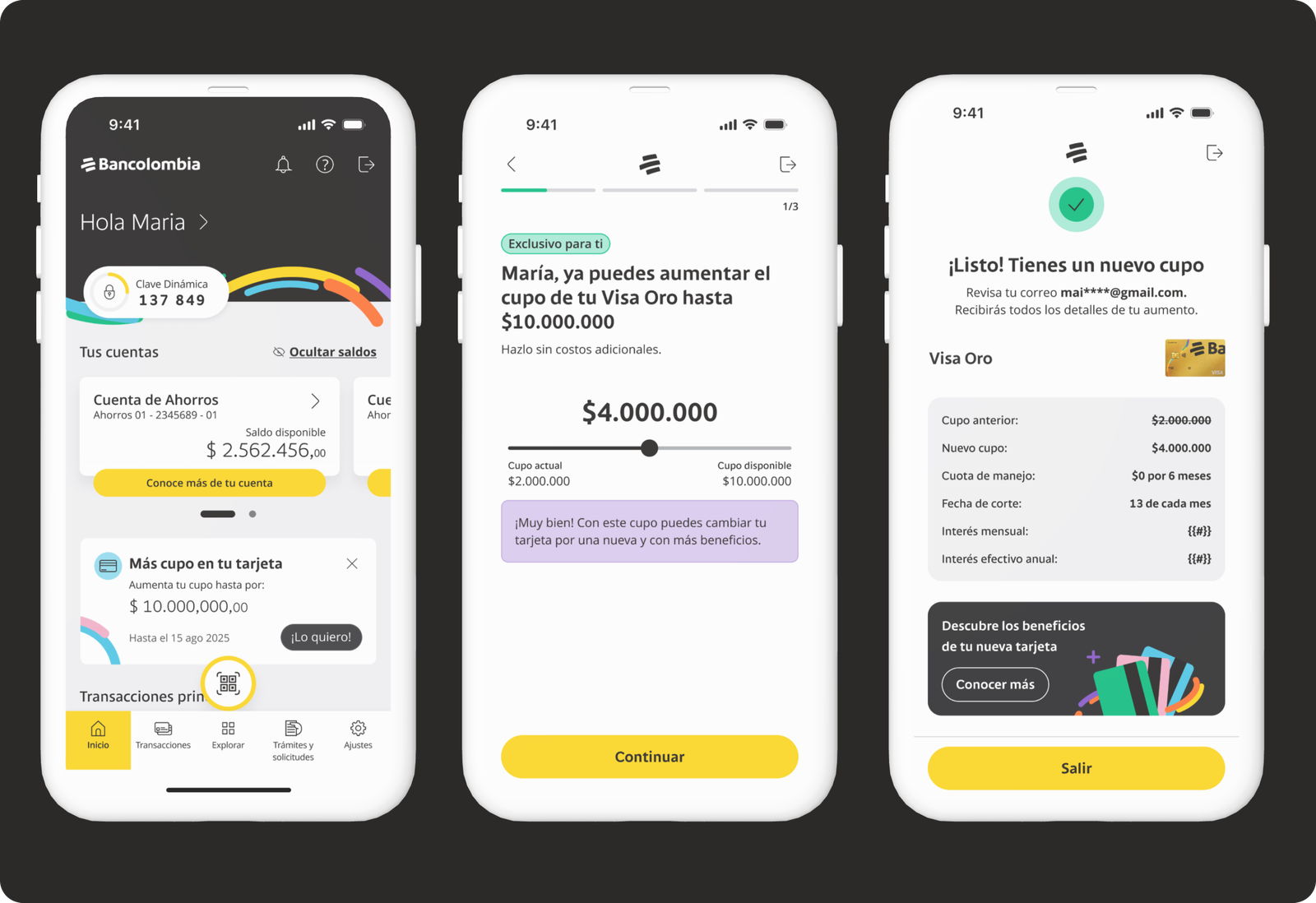
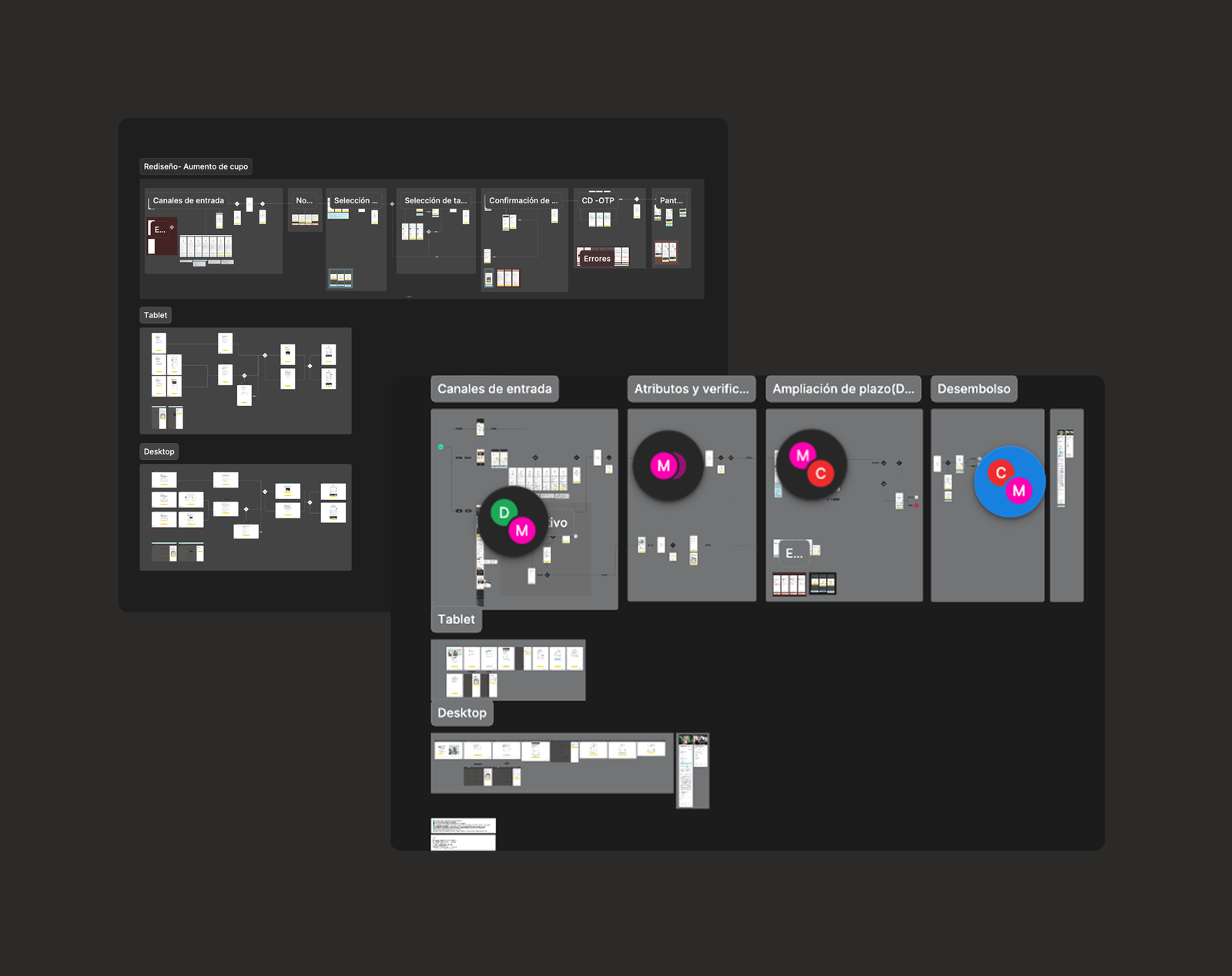
The redesign extended far beyond updating visual interfaces. Across multiple products including loan term extensions, credit card limit increases, credit line expansions, and balance transfers we rebuilt customer journeys using Bancolombia's Design System to create greater consistency, accessibility, and trust across the ecosystem.
To accelerate exploration, we adopted AI-first workflows during ideation and concept generation, allowing the team to rapidly evaluate multiple design alternatives and iterate more efficiently.
Beyond usability, we intentionally incorporated principles from behavioral science to support customer decision-making. Instead of relying solely on promotional messaging, we redesigned information hierarchy, reduced cognitive effort, improved clarity, increased confidence, and introduced behavioral interventions that encouraged informed financial decisions while supporting business objectives.
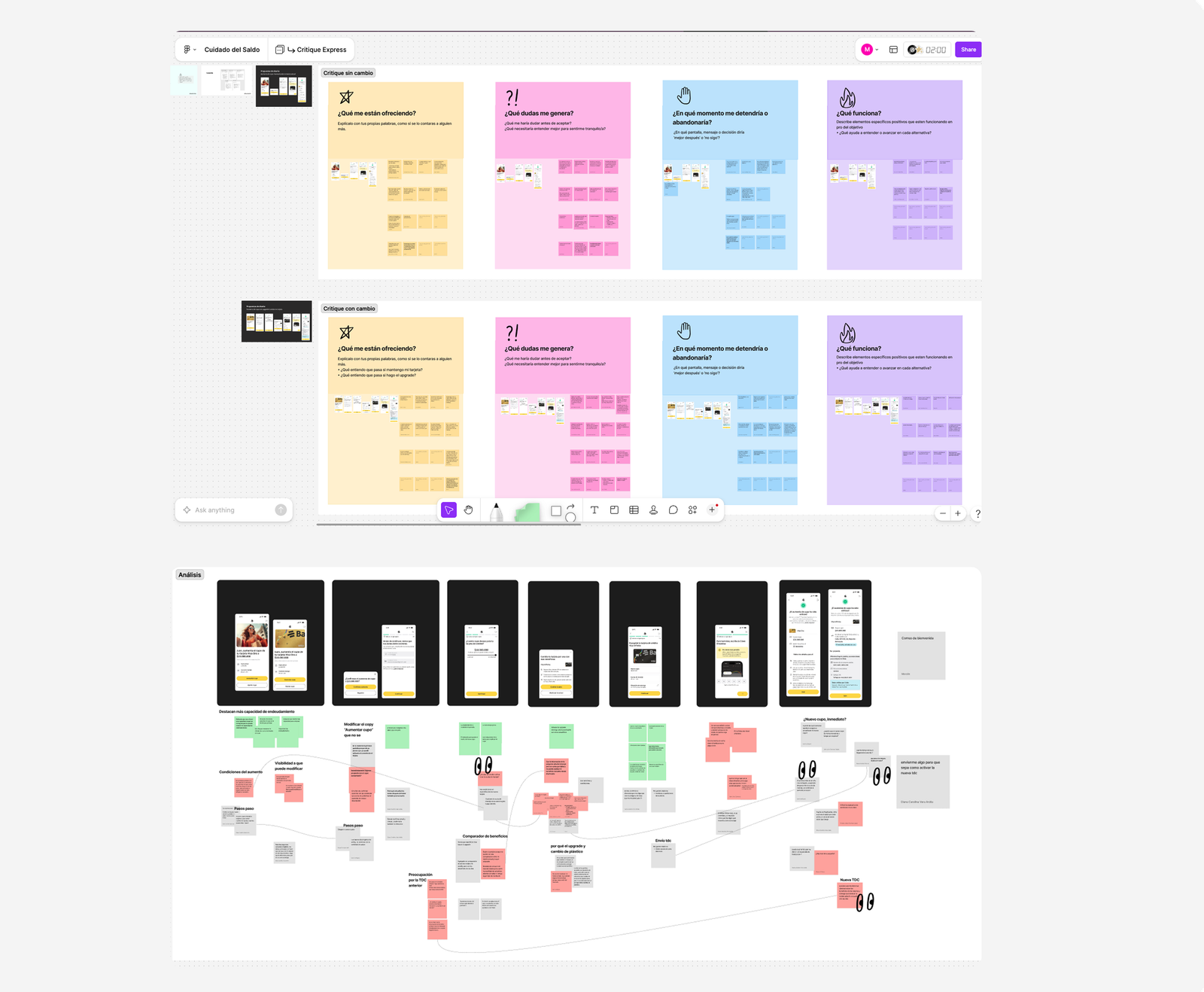
Rather than treating design reviews as isolated activities, we established regular experience critiques across the product portfolio. These sessions allowed the team to evaluate experiences from multiple perspectives, identify recurring usability issues, challenge assumptions, and prioritize opportunities for improvement based on both customer feedback and product performance.
Insights from critiques were continuously compared against business metrics, creating an iterative improvement cycle rather than a one-time redesign effort.
Portfolio grew from COP 8Bll in six months
Customer experience score maintained above
Successful customer completions
Customers now interact with a consistent ecosystem of modern post-sales experiences that are easier to understand, navigate, and complete. The redesigned journeys reduced friction while helping customers make informed financial decisions across multiple banking products.
The initiative transformed previously neglected experiences into measurable digital products. Across multiple product lines, redesign efforts resulted in significant increases in customer adoption and improved business performance.
The project also established standardized KPIs and continuous measurement practices that now guide future optimization efforts. Perhaps more importantly, the initiative shifted the organization from reactive redesigns toward evidence-based product evolution.
In just six months, the portfolio grew from COP 8 billion to COP 30 billion approximately USD 7.7 million in 2025 an amount comparable to the cost of building a world-class airport.
The project created a shared operating model across multiple disciplines. Rather than optimizing products independently, teams began working through a common framework built around:
This transformed disconnected initiatives into a coordinated product ecosystem capable of evolving over time.
This project fundamentally changed how I think about product design. The most valuable contribution wasn't redesigning individual interfaces it was helping multiple disciplines align around a shared product strategy grounded in customer behavior, measurable outcomes, and continuous learning.
I also learned that successful enterprise products require balancing customer needs with business goals, technical realities, organizational priorities, and market expectations.
When experience strategy, behavioral science, product thinking, and measurement work together, design becomes more than interface creation it becomes a driver of long-term product and business growth.
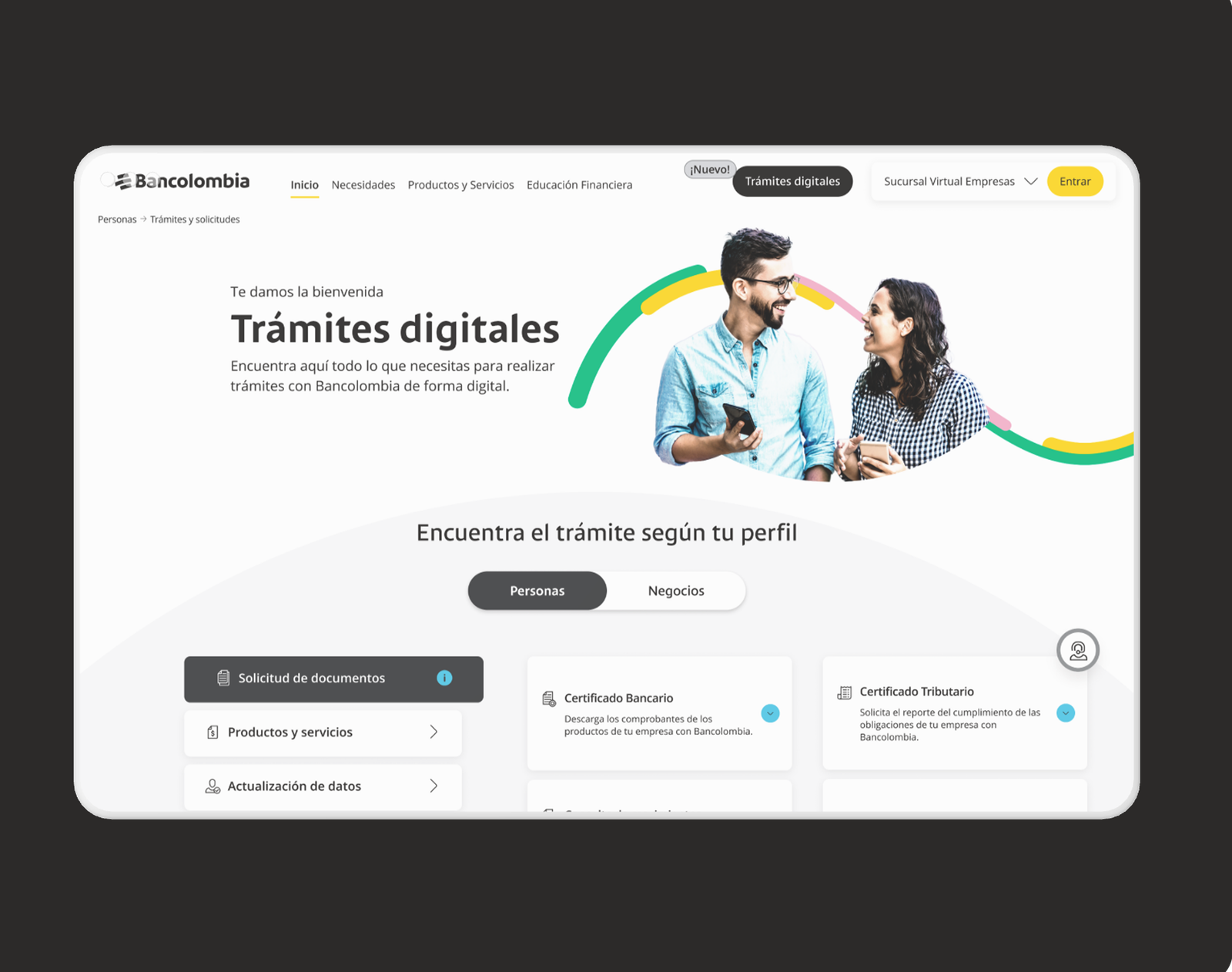
Replacing paper-based banking requests with a seamless end-to-end digital service.
Every day, Bancolombia customers completed hundreds of procedures related to their banking products from updating personal information to requesting new services.
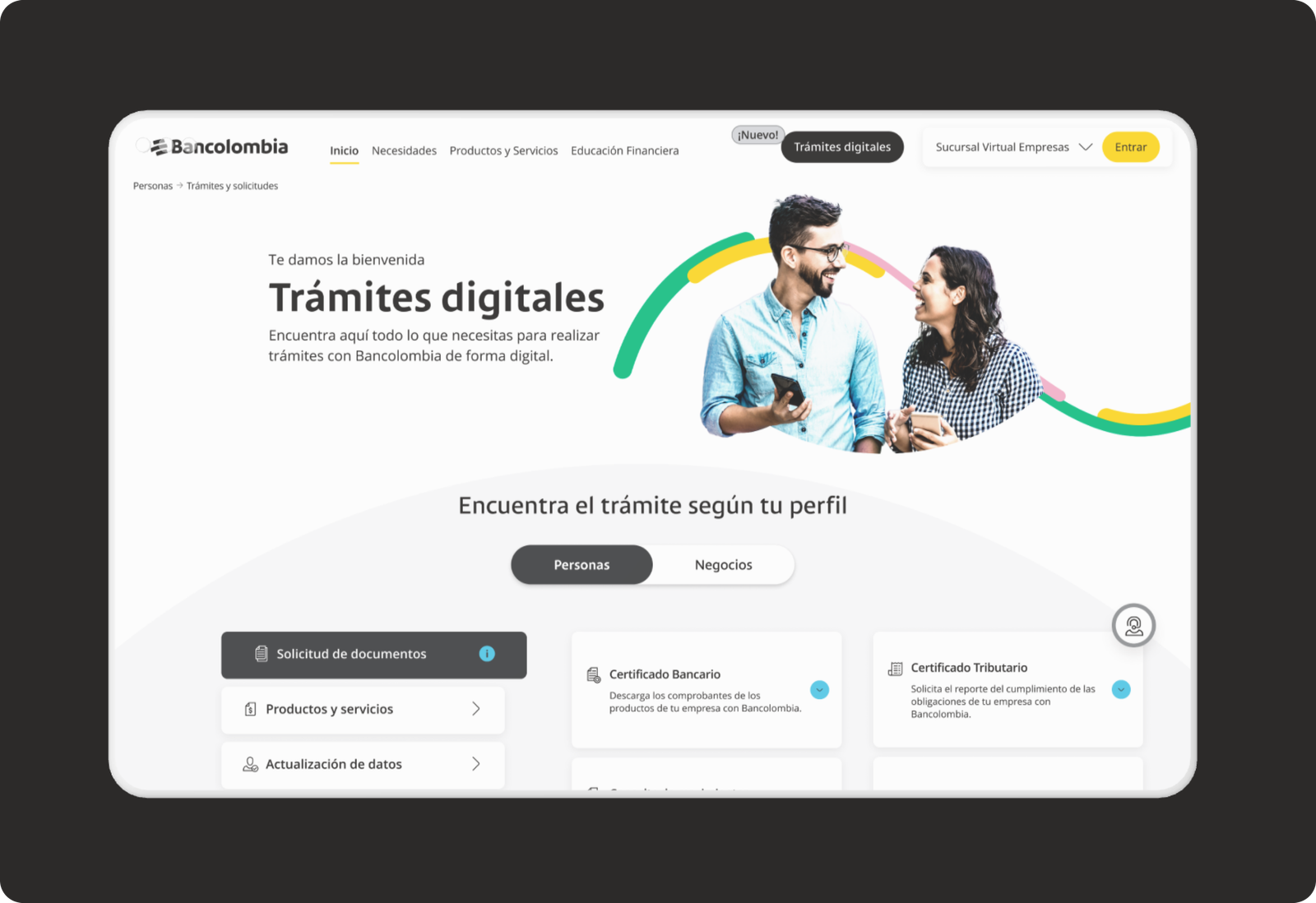
Although many of these processes started online, they still depended on paper forms. Customers were required to download a PDF, print it, complete it by hand, scan it, and upload it again before the bank could process the request.
This fragmented experience created friction for customers, generated unnecessary operational work, and slowed down service delivery.
The opportunity wasn't simply to digitize forms. It was to redesign how banking procedures worked from end to end.
The existing experience allowed customers to request certain documents online, but most banking procedures still relied on manual paperwork. To complete a single request, customers had to:
Each additional step increased customer effort while creating rework for operational teams responsible for reviewing documentation.
The challenge wasn't redesigning a form. It was transforming an entire service that still behaved like a paper-based process.
The project started with a future-state proposal (TO BE) developed by an external consultancy. Rather than moving directly into design, our responsibility was to evaluate that proposal, understand the operational ecosystem behind it, and determine what could realistically be delivered.
Aligning business and technology
We facilitated collaborative sessions with Product Owners, Solution Architects, developers, and business stakeholders to understand technical constraints, operational priorities, and customer expectations. These conversations revealed that success depended as much on organizational alignment as on interface design.
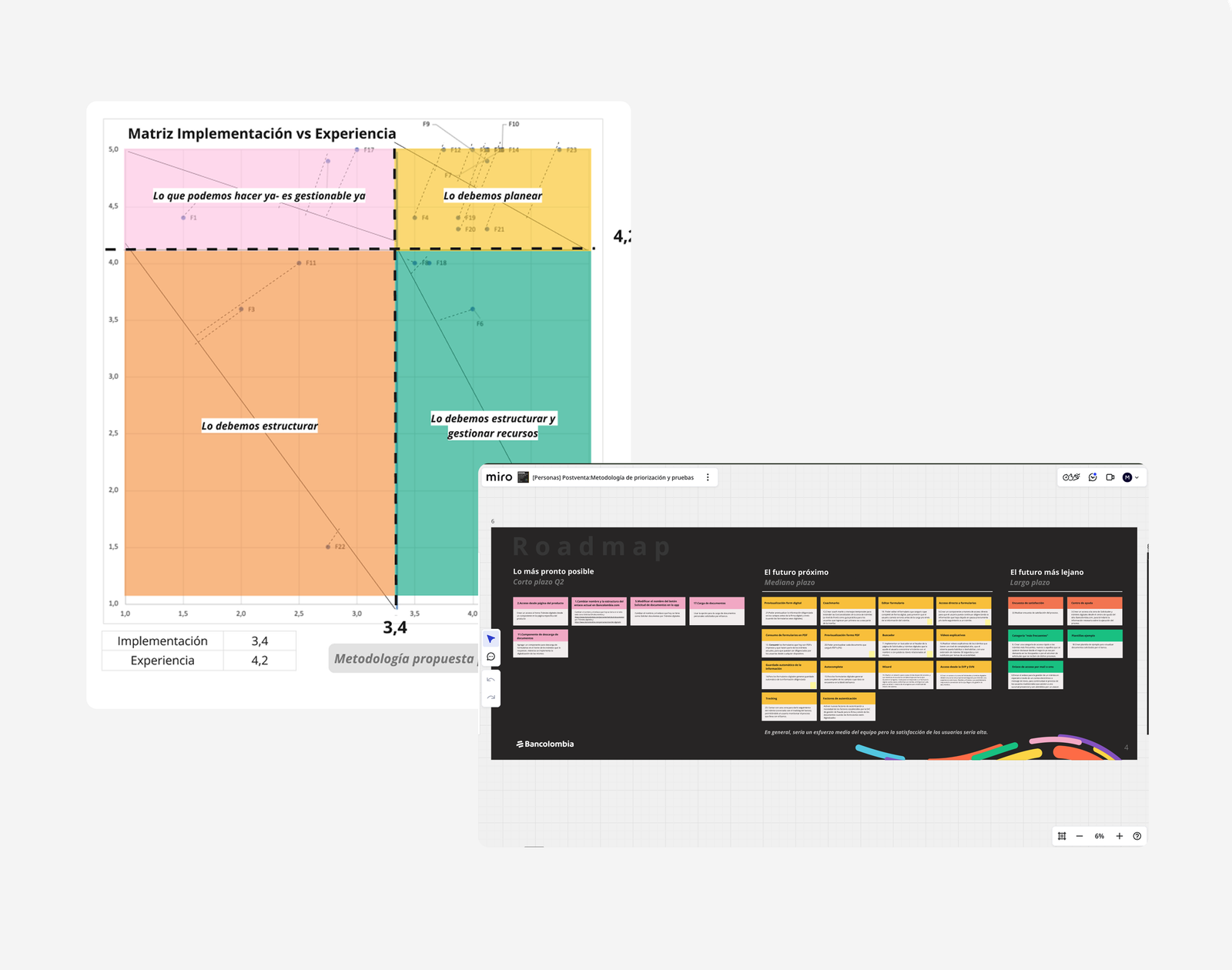
Rather than deciding priorities based solely on business assumptions, we evaluated every proposed capability from two complementary perspectives. Working with technical teams, each functionality was assessed according to its implementation feasibility using a five-point scale. In parallel, customers evaluated the perceived value of each capability based on the impact it would have on their experience.
We combined both perspectives into an Experience vs. Implementation matrix that allowed us to identify quick wins, strategic investments, and lower-priority opportunities.
The prioritization process also helped define a set of foundational capabilities that every digital banking procedure needed to include from the very first release establishing shared experience standards across the ecosystem:
The greatest source of friction wasn't the interface. It was the dependency on physical documents.
As long as customers had to move between digital and paper interactions, the experience would continue to feel fragmented. The opportunity was to redesign the service so that completing a banking procedure could happen entirely within a single digital journey.
After defining priorities, we collaborated with more than 30 cross-functional teams to refine the future-state experience, validate requirements, and adapt the proposal to operational and technical realities.
Instead of designing an idealized solution, we continuously balanced customer value, implementation complexity, and business priorities. This collaborative process transformed a conceptual service proposal into a realistic implementation roadmap.
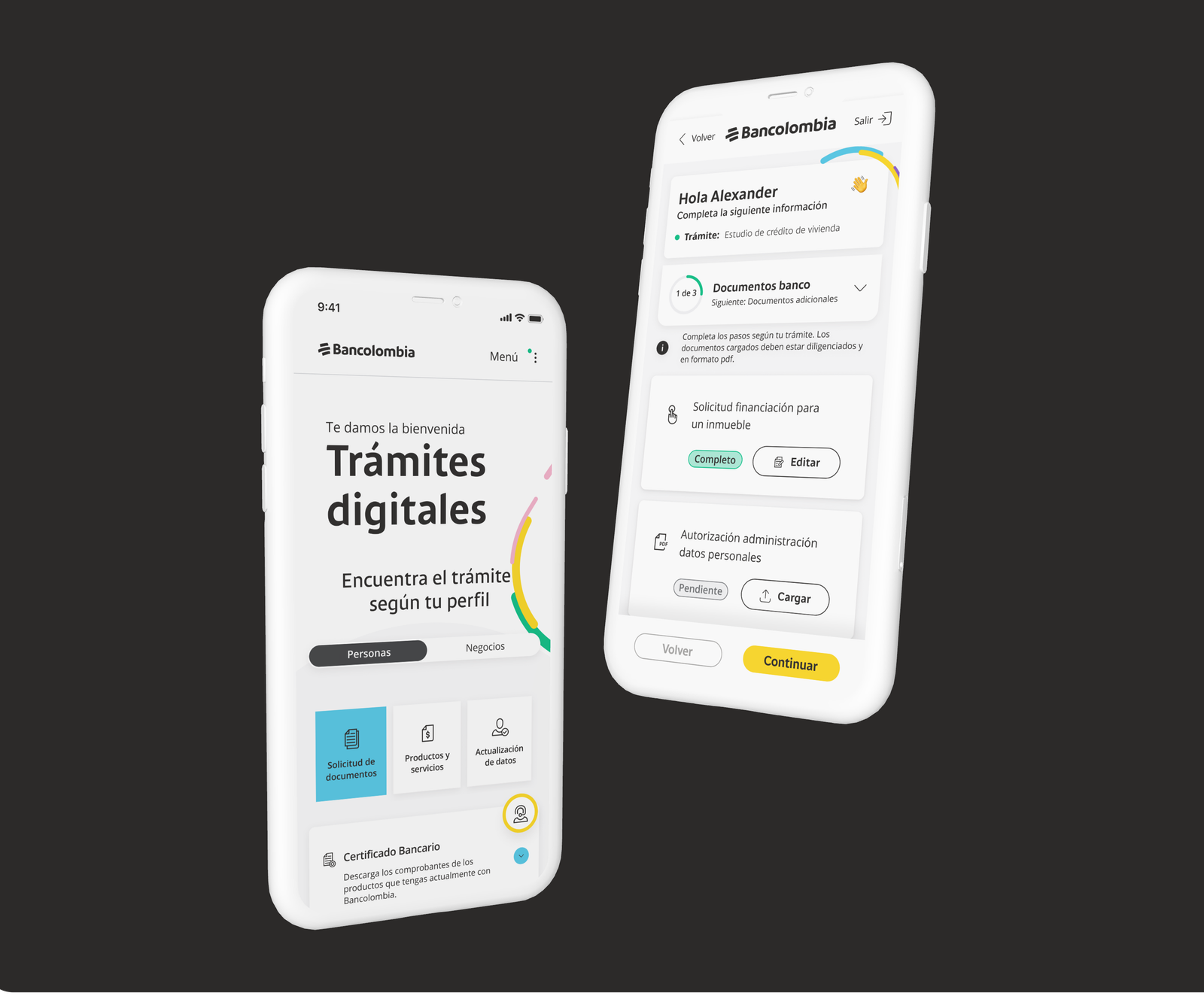
The redesigned experience replaced manual paperwork with digital interactions. Customers could complete digital forms, upload supporting documentation directly within the experience, and electronically sign their requests without leaving the digital journey.
Using Bancolombia's Design System, I designed the end-to-end experience including digital forms, document upload flows, and electronic signatures.
To improve findability and comprehension, we collaborated with the SEO and Content Design teams to evaluate naming alternatives based on search behavior, content strategy, and tone of voice. We also validated the information architecture through card sorting and tree testing using Optimal Workshop before moving into interface design.
The resulting prototypes were continuously refined through usability testing, first-click testing, interviews, surveys, and eye-tracking studies ensuring the experience remained intuitive, accessible, and technically feasible.
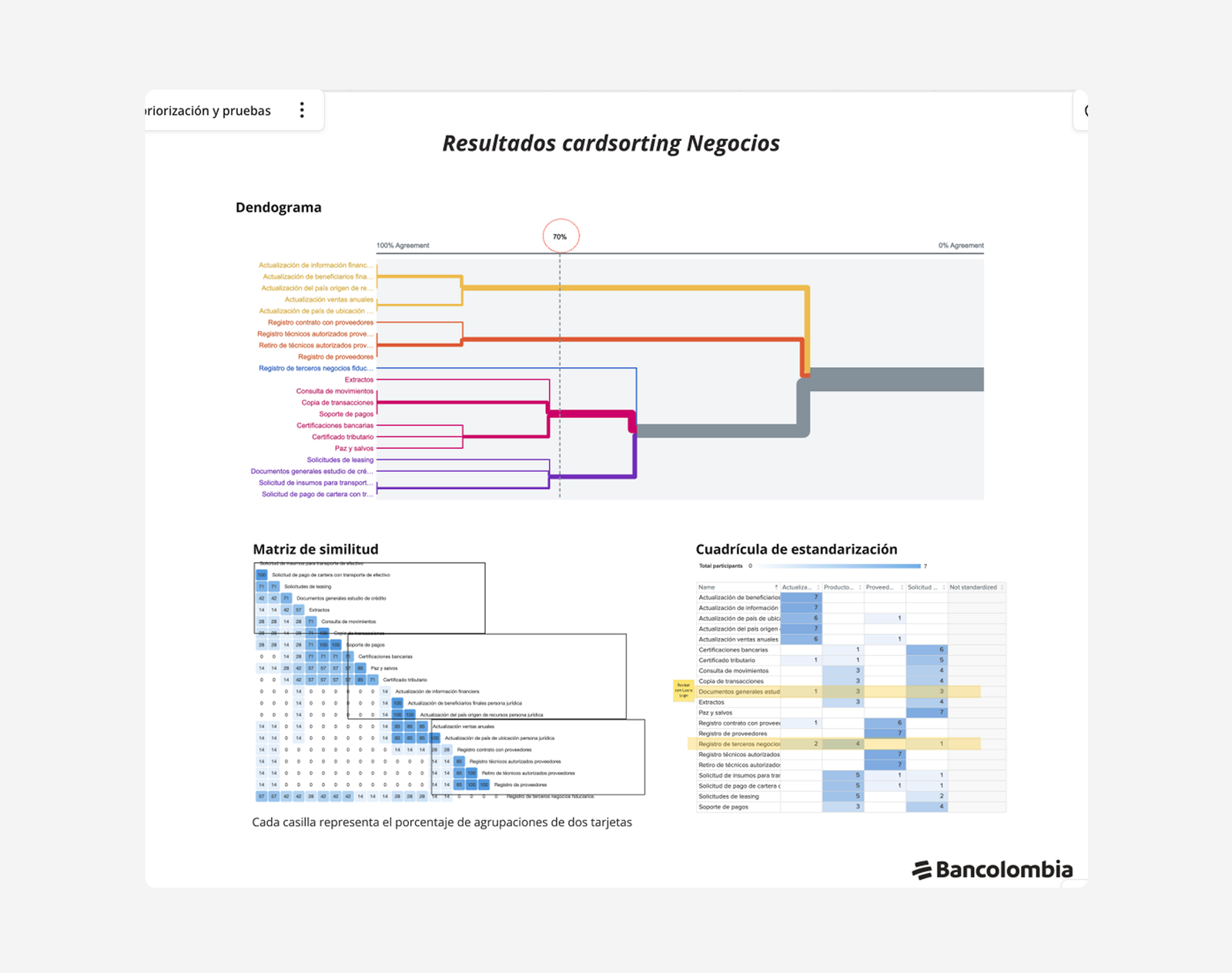
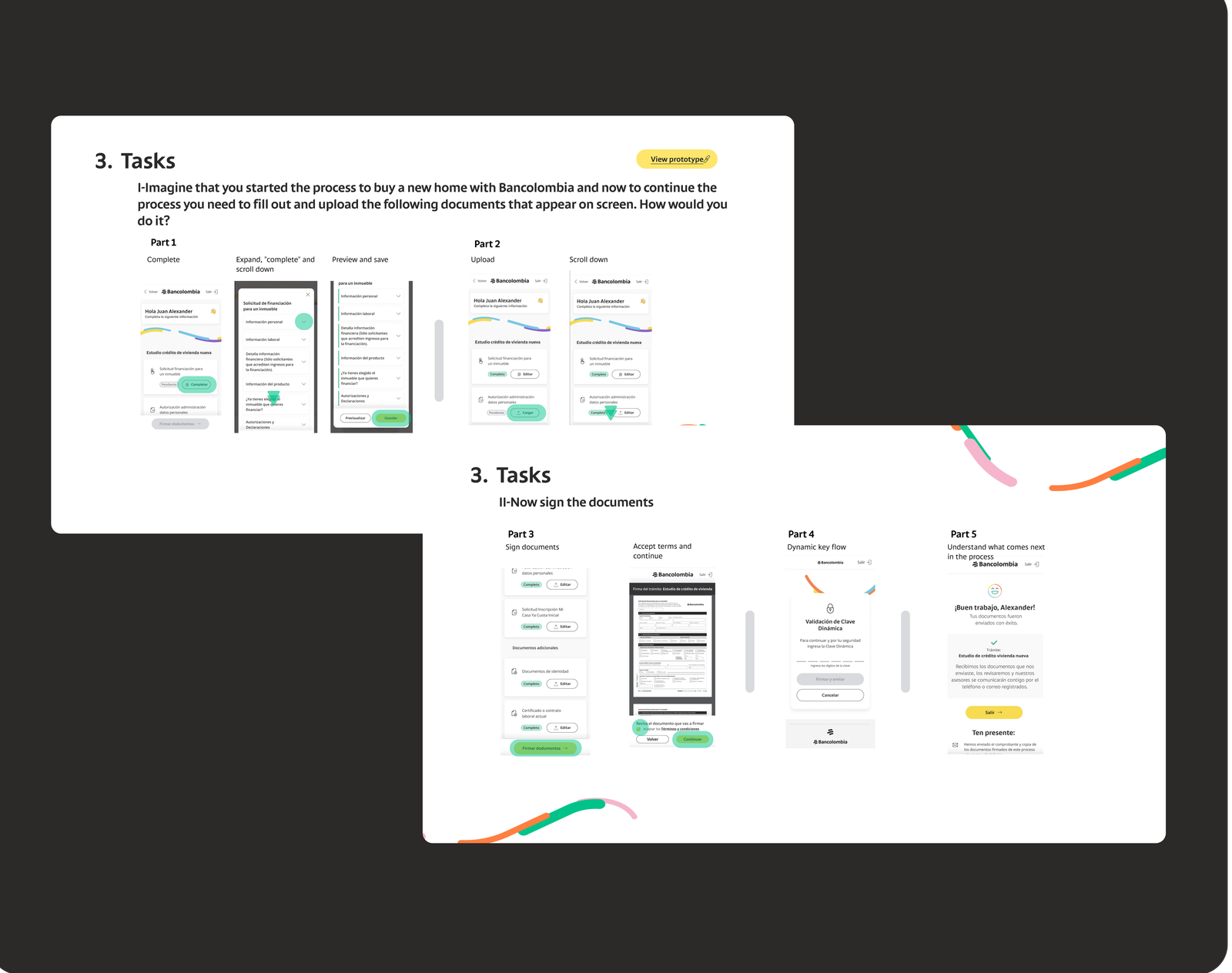
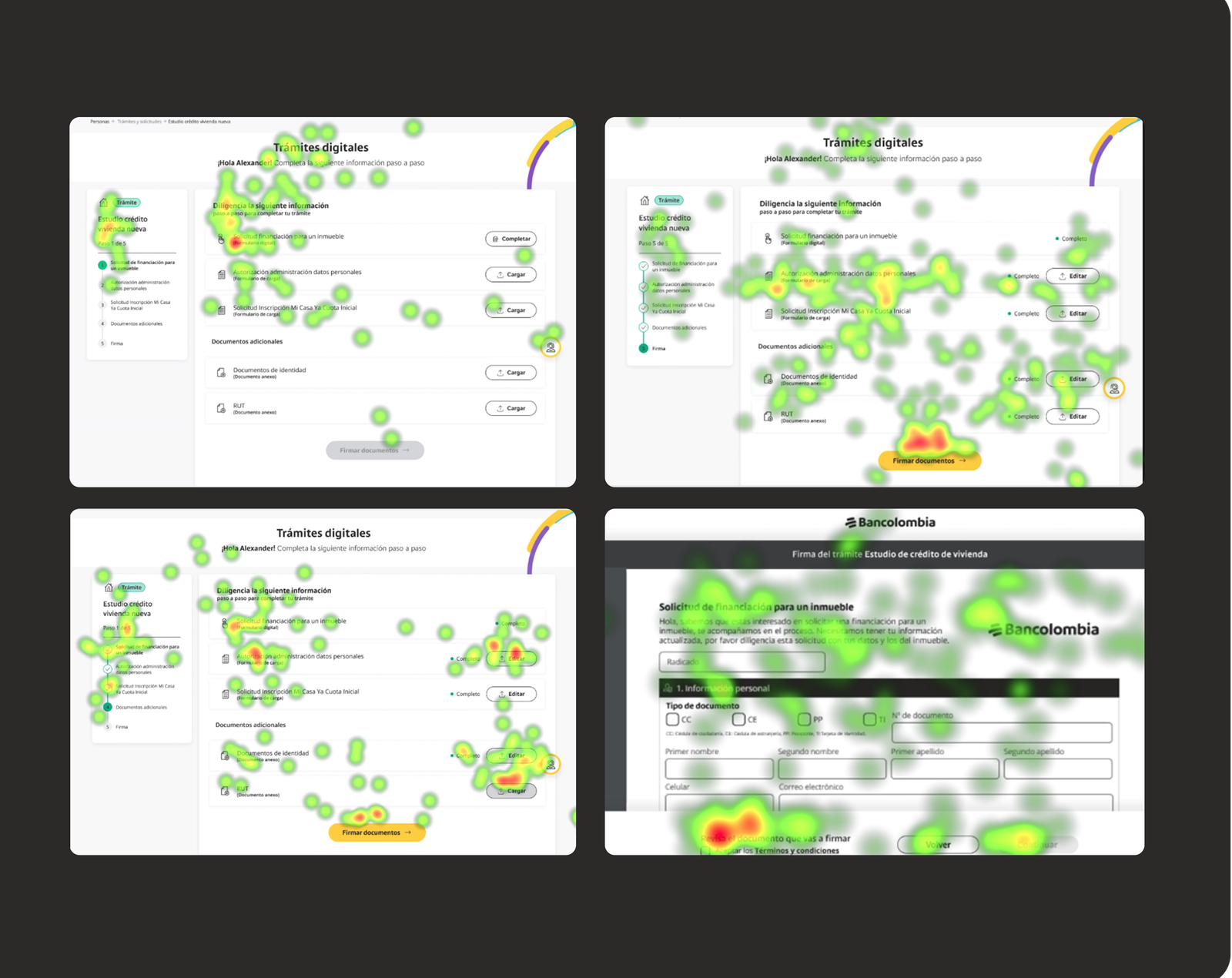
The new experience eliminated many of the manual steps previously required to complete banking procedures. Instead of downloading, printing, scanning, and re-uploading documents, customers could complete supported procedures through digital forms, document uploads, and electronic signatures all within a single experience.
The project established the strategic foundation for Bancolombia's digital procedures ecosystem. However, not every procedure could be launched immediately a third-party platform responsible for rendering digital forms introduced technical limitations that prevented all procedures from being digitized during the initial release.
Rather than delaying the initiative, the team prioritized the procedures that were technically feasible while defining a scalable roadmap for progressively migrating the remaining services. This approach allowed the organization to begin reducing operational reprocessing while continuing its broader digital transformation.
Beyond delivering a redesigned experience, the project introduced a shared prioritization framework that aligned customer value, technical feasibility, business priorities, and vendor dependencies before implementation.
This framework became the foundation for defining the MVP, sequencing future releases, and allocating development resources across the ecosystem.
This project reinforced that successful enterprise products are shaped by much more than good interface design. In complex organizations, technical dependencies, vendor capabilities, and operational constraints often determine what can be delivered and when.
Rather than pursuing the perfect solution, I learned to design adaptable roadmaps, prioritize incremental value, and help multidisciplinary teams make product decisions that balanced customer needs with business and technical realities.
The most valuable skill wasn't designing the ideal experience. It was helping the organization navigate complexity to deliver real value incrementally.
Over the past five years, I've designed digital products for the media and financial industries, leading research, experimentation, and end-to-end product design initiatives. I currently work at Pragma in partnership with Bancolombia, where I help transform lending and credit card experiences by combining user research, product metrics, and experimentation to drive evidence-based design decisions.
More recently, I completed a Master of Design in Strategic Foresight & Innovation at OCAD University in Toronto. During my master's, I collaborated with organizations such as CASPAR, presented my graduate research at the Innovation Forum, and delivered a TEDx talk at OCAD University.
Today, I work at the intersection of research, strategy, and product design, creating experiences that generate meaningful value for both people and businesses.

Contributed to a Colciencias-funded research project (now the Ministry of Science, Technology and Innovation of Colombia).
Built a strong foundation in human-centered design through research, and interdisciplinary collaboration.
Designed digital experiences across Colombia's leading news ecosystem, including ELTIEMPO.com, EL TIEMPO App, Futbolred, Portafolio, Citytv, and ADN.
Also delivered internal UX training programs for multidisciplinary teams.
Designed and optimized end-to-end digital experiences for lending and credit card products, combining user research, product strategy, experimentation, and UX design.
Expanded my practice through futures thinking, systems innovation, and strategic design.
Highlights:
Throughout my career, I've found that my greatest impact often extends beyond the products I design. I enjoy helping teams, practices, and organizations grow by sharing knowledge, strengthening design quality, and introducing new ways of thinking.
I contribute to scaling design beyond individual projects by creating reusable frameworks, documenting best practices, and improving design processes. At Pragma, I co-created UXersLab, an internal knowledge hub that helped standardize UX practices and enabled designers to work more consistently and efficiently.
I enjoy supporting designers through mentoring, design critiques, and cross-functional collaboration. While leading a small Product Design cell, I helped facilitate product decisions, foster collaboration, and create an environment where designers could learn and grow together.
I advocate for accessible, measurable, and consistent product experiences. Across multiple initiatives, I've promoted accessibility, Design Systems, and shared experience standards to help teams build products that are both usable and scalable.